

Book available now · Platform live now
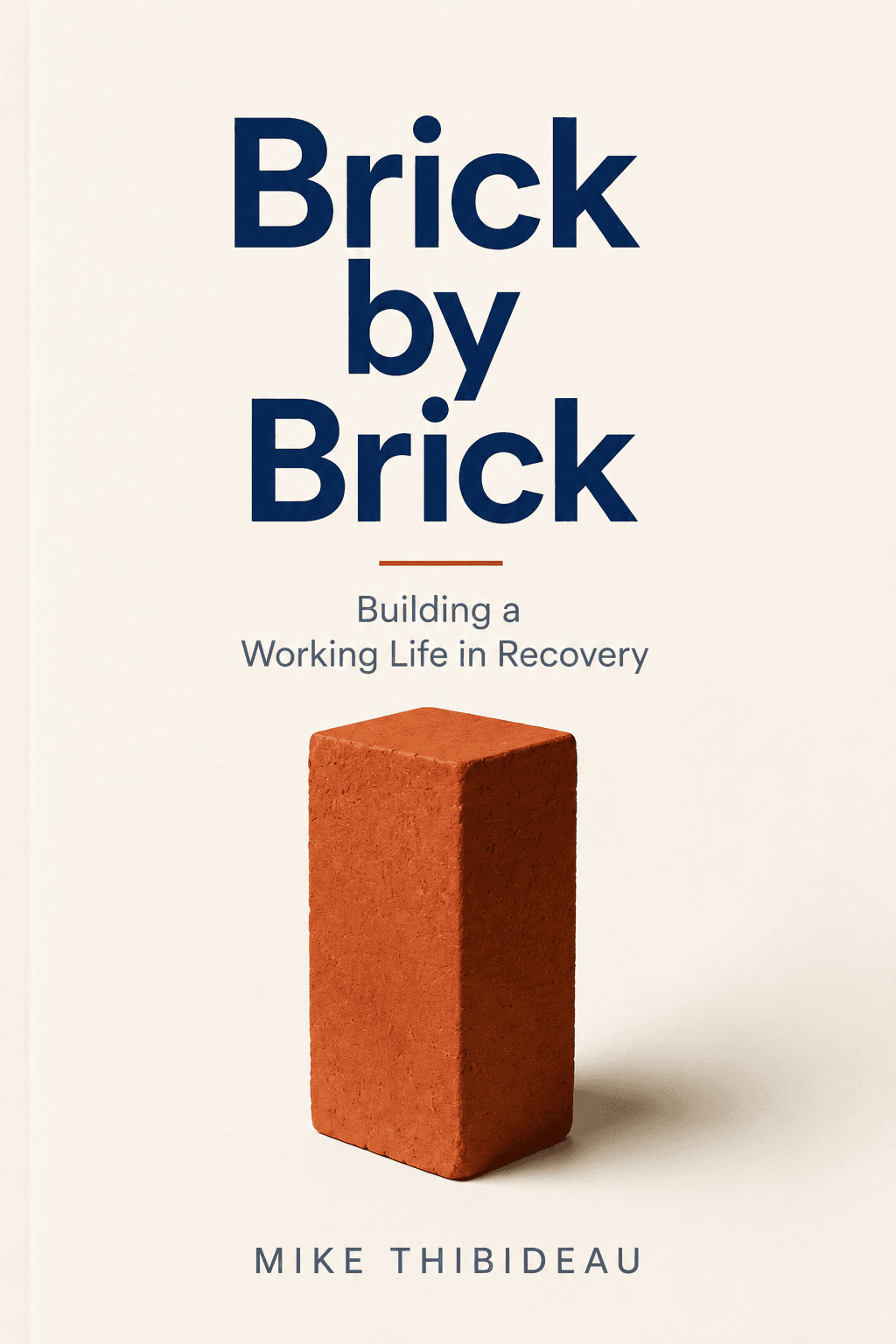
BrickbyBrick
Building a Working Life in Recovery

Ten years ago I couldn’t have told you what I wanted for lunch, let alone what I wanted for a career.
A lot of us in recovery know that fog. You don’t get a Gandalf showing up at your door with a quest. You don’t get a Hogwarts letter. You get a Tuesday, and a phone, and a question about what to do next.
And then somebody hands you a stack of generic career advice on top of all that… and you close the tab.
This book and this platform are the other thing. The conversation about work that actually fits where you are.
Prefer Kindle? Get the Kindle edition on Amazon →
Bought the book on Amazon or elsewhere? Claim your platform discount →
By Mike Thibideau · ISBN 979-8-9961450-0-3 · Paperback & Kindle
The Brick by Brick Ecosystem
One philosophy. Many paths forward.
The book
For people in recovery figuring out the work part of life.
Most career advice for people in recovery skips the actual question. It isn’t which path is correct. It’s who am I now, and what kind of work fits who I’m becoming?
The book walks the reader through ten chapters of stories at different stages of recovery and different shapes of the work question. Lena, three years sober, returning to full-time hospital administration. David, two years sober, former software developer in an operations role. Calvin, two and a half years sober, navigating an HVAC interview with a felony record. Tasha, twenty months sober, considering an LPN program. Jordan, one hundred ten days sober, six years of restaurant work, no career-shaped path yet. Greg, ninety-three days sober, medical device sales executive with a household built to his current income.
The reader watches the road being walked. Then walks it themselves.
Recovery Career Compass
A Brick by Brick Platform
Navigate your path. Build your future.
Where the conversation becomes a practice.
Structured tools that move the book’s frameworks off the page and into your own situation. Each one gives you something you can carry… a one-page artifact for the conversation with your sponsor, counselor, or coach.
The platform is an annual subscription. The book comes with a code that takes a chunk off your first year. IHC program participants get the year free through their staff. Enterprise pricing for treatment programs, recovery community organizations, and employers building recovery-friendly workplaces… get in touch.
Readiness Assessment
An honest check-in across four dimensions… your practical floor, your skills and credentials, where you are mentally and emotionally, and what the local job market actually looks like. No verdict. Just a clear picture of where you stand.
Mission Statement Builder
The door is not the test; the mission is. Guided prompts to articulate why you're here, who you're here for, and what your work is for. One paragraph, your voice. Built to be revisited.
Show Up Whole
Interview-presence prep, four short sections. You pick the values you keep coming back to, translate them to the role you're going for, and draft three rehearsed answers for the questions that catch most people off-guard. Walk in as yourself.
Disclosure Templates
Acknowledge → Accountability → Forward-Pivot… the three-move mechanic from Chapter 6, rendered as templates you fill in your own words. The boss conversation, the cover letter paragraph, the resume gap framing. Your choice, your timeline, your words.
WOOP Goal Builder
Wish · Outcome · Obstacle · Plan. An evidence-based goal-setting framework from Oettingen and Gollwitzer, calibrated for the pace of recovery. One career-related goal at a time, with explicit if-this-then-that rules for the obstacles you know are coming.
Career Story Builder
The honest story of your work history — where you started, where you drifted, where you turned, and who you're becoming. One page you carry into any interview. Translates your real path into language an interviewer can hear without making you into something you're not.
Active Job Search Builder
Five short sessions across five weeks. Target list, application tailoring, outreach cadence, interview rehearsal, what to do when nothing's landing. The structured pace of an actual job search, in your hands.
First 90 Days Companion
Day one to day ninety at the new job. Who to talk to, what to learn fast, where the recovery practice fits in your week. The onboarding window is where the integration is most fragile; this is the plan.
Workplace Resilience Companion
Five situations a lot of us in recovery find disproportionately rough at work… the short-tempered boss, the underperformer the manager won't address, the celebration day, and others. A three-minute desk practice for each. A check-in instead of a spiral.
Weekly Practice Planner
Sunday-night plan, daily cadence, Friday review. The simple weekly rhythm that keeps a working life from running you over.
Action Plan Builder
Everything from the other tools pulled into one 1-3 page plan you take to someone you trust — a mentor, friend, counselor, or coach. The end-of-book exercise, made tangible.
Additional tools are in development; they’ll ship as they’re ready. All of them are live on day one.
Inside the book
Ten chapters, each one carrying a practical framework.
Each chapter sits next to a tool in the Recovery Career Compass. Read the chapter, then use the tool to apply it to your own situation.
The Three Tests
Three questions for any work decision in recovery: Does this use what I have? Does this keep the floor under us? Does this move me toward who I'm becoming? A direction that passes all three is workable; a direction that fails one is not the move. (Chapter 2.)
Show Up Whole
The four-part frame for whole-person interview presence — Mirror, Bridge, Story, Boundary. How to bring all of who you are into the room without over-explaining or under-showing-up. (Chapter 6.)
The disclosure mechanic
Acknowledge → Accountability → Forward-Pivot. A three-move structure that holds any hard professional conversation together — drawn from the work of the Center for Employment Opportunities, one of the few approaches in this field with real research behind it. (Chapter 6.)
WOOP goal-setting
Wish · Outcome · Obstacle · Plan. An evidence-based goal-setting framework from Oettingen and Gollwitzer, calibrated here for the pace of recovery. One career-related goal at a time. (Chapter 10.)
The three conversations after a slip
Sponsor first. Partner next. Workplace last, and only when needed. The order matters; the shape of each conversation matters more. Plus how to know when a slip is a slip versus the start of a fall. (Chapter 9.)
Reading a recovery-friendly workplace
Recovery-friendly is a posture, not a policy statement. The five signals that tell you whether a workplace will actually receive your recovery well, and the three that look reassuring but mean nothing. (Chapter 6 + Chapter 8.)
Pacing the return to work
The work-as-replacement trap. The lost-time math the rest of the world keeps selling. The doctor's recommendation that gets ignored because the rent is due. How to navigate the work-vs-treatment pressure before the slip can happen. (Chapter 3 + Chapter 4.)
Doing MY job
What it actually takes to show up consistently at a new job in early recovery. Side-of-the-street work. The futility-of-criticism discipline. Three layers of asking for help. The daily practice of the eight hours. (Chapter 8.)
The mission, not the door
The door is not the test; the mission is. A one-paragraph personal mission becomes the anchor that every career decision gets weighed against. The job is downstream; the mission is upstream. (Chapter 2.)
From the writing desk
Long-form essays.
Free, sit-alongside-the-book reads. Each one is a thousand words shorter than the chapter it sits next to, and a thousand readers wider in audience. New essays a few times a year.
Essay · 14 min read
Returning to work in recovery
How long after rehab can you return to work? The question itself is wrong, and there's a better one.
Read →
Essay · 12 min read
Disclosure in job interviews
Your choice. Your timeline. Your words. A framework for the decision and a three-move structure for the conversation itself.
Read →
Essay · 11 min read
What makes a workplace actually recovery-friendly
“Recovery-friendly” is a posture, not a policy statement. The signals that actually matter.
Read →
About Mike
Why I'm the one writing this.
I’ve spent my career in workforce development… building programs that help people who’ve been knocked off their path find work that lasts. People coming out of incarceration. Out of treatment. Out of long stretches of unemployment. The kinds of stories the data alone never quite captures. At the same time I use my love of data to help employers find people that thrive where they work.
I’m also a person in long-term recovery. Ten years. I’ve had my own experiences with homelessness, with starting over, with figuring out where work fits.
The credentials gave me access to the data and the systems. The personal road taught me what the data alone could not.
Day job: I lead Invest Hamilton County, a workforce-and-economic-development organization in central Indiana. Brick by Brick Strategyis my personal company; the work here is mine alone… not Invest Hamilton County’s, not its Board’s, not any of the other organizations I’m affiliated with.
Strategy & Speaking
Brick by Brick Strategy, LLC.
Clarity. Direction. Execution.
I take on a few strategy and advisory engagements each year. Civic-institution strategy. Recovery-friendly workplace consulting. Board advisory. Speaking. If the work fits what I do well, get in touch.
 Clarity
 Direction
 Execution